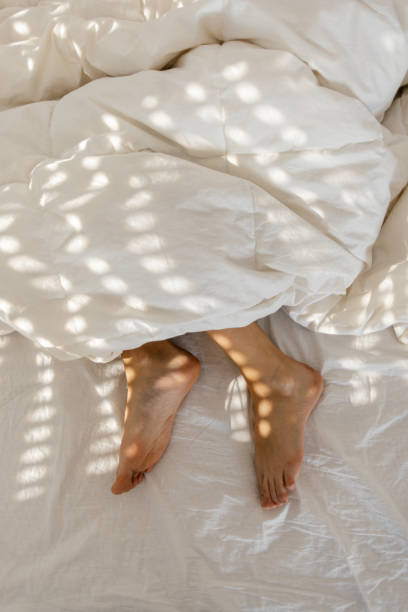
Sleep Is Where Design Becomes Personal
You can feel it before you understand it.
What actually happens to our bodies, materials and homes when there is too much water in the air?
Sleep Is Where Design Becomes Personal
What if the place where we spend a third of our lives was designed around the body, the material and the climate?
Sleep is one of the most intimate relationships we have with our environment.
For around eight hours every night, our bodies are continuously interacting with textiles, temperature, moisture, airflow, light and sound.
Our skin is touching a sheet. Our head is resting on a pillow. A mattress is holding heat beneath us. Fabric is moving against the body. Air is circulating—or not circulating—around the room.
And while all of this is happening, we're trying to do something incredibly important:
Sleep.
Yet we rarely think about sleep as a design system.
We buy a mattress. We buy sheets. We buy pillows. We add a blanket. Perhaps we turn on a fan or air conditioning.
But what if we started somewhere else?
What does the sleeping body actually need here?
The bedroom has its own climate
Every night we create a small climate around ourselves.
The temperature of the room is only one part of it.
There is also the temperature underneath the body, the warmth trapped between layers of bedding, the moisture produced by the skin, the breathability of the mattress, the weight of a blanket and the air moving around the bed.
Change one of those things and the experience of sleep can change.
Anyone who has tried to sleep through a hot, humid tropical night knows this instinctively.
You turn the pillow over looking for the cool side.
You push the blanket away.
You move your leg outside the sheet.
You increase the fan.
The body is constantly trying to regulate itself.
Good sleep design should help it.
Why do we sleep in the same materials everywhere?
This is one of the questions that started our research.
Why should someone sleeping in Tulum use essentially the same sleep system as someone living in London?
The climates could hardly be more different.
In Tulum, nights can be hot and humid. Moisture, airflow and heat release become incredibly important.
In the highlands of Oaxaca, nights can be cooler and drier, with significant changes in temperature between day and night.
And yet bedding is largely sold as a universal product.
Thread count.
King or queen.
Soft or firm.
Summer or winter.
We rarely talk about place.
But perhaps the first question when choosing a sleep system shouldn't be:
What kind of sheets do I like?
It should be:
Where am I sleeping?
This is where bioclimatic design becomes very personal
We normally associate bioclimatic design with architecture.
The orientation of a building. Solar gain. Ventilation. Shade. Thermal mass.
But the same thinking can happen much closer to the body.
A sheet can be bioclimatic.
Sleepwear can be bioclimatic.
A pillow can be bioclimatic.
The question is the same:
How can this design help the body respond to the conditions around it?
In a hot, humid environment, we might prioritise lightweight materials, open weaves, airflow, moisture movement and quick drying.
In a cooler, high-altitude environment, the system may need to hold warmth differently while remaining breathable and comfortable against the skin.
Neither is inherently better.
They are simply responses to different places.
The right material. For the right body. In the right climate.
Material matters when you're touching it for eight hours
We spend a surprising amount of our lives touching our bedding.
That makes the bed one of the most interesting places to explore material intelligence.
Not simply whether a textile is natural, synthetic, luxurious or sustainable.
But how it actually behaves.
How does it feel when the body becomes warm?
What happens when the skin perspires?
Does moisture remain close to the body or move away?
How quickly does the material dry?
How much air can move through the weave?
How does it change after fifty washes?
How does sensitive skin respond?
Does it become softer with time?
Does it last?
These questions are becoming part of the way we work with linen, cotton, TENCEL™ Lyocell, silk and cupro.
Instead of choosing a material because it belongs to a particular aesthetic, we want to understand what the material can do.
Sensitive sleepers can teach us a lot
Some people can sleep almost anywhere.
Others notice everything.
A crease in the sheet.
A pillow that's too warm.
A fabric that feels slightly rough.
A room that's too humid.
Light coming through a curtain.
A small change in temperature.
Rather than seeing these people as difficult sleepers, I think they can teach us something.
Sensitive bodies give us very detailed feedback about an environment.
They show us where there is friction.
And if we can design a sleep environment that works beautifully for a highly sensitive body, there's a good chance we've created something that feels wonderful for many other people too.
Sleepwear is part of the bed
This is another distinction that doesn't make much sense to me.
We design sleepwear as fashion and bedding as homeware.
But the body experiences them at the same time.
Your pyjamas, sheet, pillow, mattress, blanket and room are all creating one microclimate around you.
So why wouldn't we design them together?
A breathable sheet makes less sense beneath sleepwear that traps heat.
A beautifully ventilated room can only do so much if the bedding creates a warm pocket around the body.
Once we begin with the sleeping body, the traditional product categories start disappearing.
Instead, we see a sleep system.
And the sleep system eventually becomes a room
This is where our research starts expanding.
We begin with the material touching the skin.
Then the sheet.
The pillow.
The blanket.
The mattress.
But eventually we reach the edge of the bed.
Then we have to think about the bedroom.
Where does the morning sun enter?
Where does the evening heat accumulate?
Can air move across the bed?
Can the room be naturally ventilated?
What materials are on the walls and floor?
What happens to humidity?
How dark does the room become?
What can we hear?
What can we smell?
Suddenly we're no longer designing bedding.
We're designing an environment for sleep.
And eventually that question reaches the architecture itself.
Tulum and Oaxaca: two places, two sleep systems
This is why we are beginning our bioclimatic sleep research in two radically different Mexican territories.
Tulum and Oaxaca.
Tulum gives us the tropics: heat, humidity, intense sun, heavy rain and lush vegetation.
Oaxaca's highlands give us altitude, drier air, strong sunlight, cooler nights and very different temperature rhythms.
We don't want to create one sleep system and simply change the colour for each place.
We want the places themselves to influence the design.
Different material weights.
Different combinations.
Different layers.
Different relationships with airflow and warmth.
Potentially even different local materials and making traditions.
The difference is the point.
Because this is really an experiment in a larger idea:
What happens when products belong to places again?
Sleep is only the beginning
We chose sleep because it makes the relationship between body and environment impossible to ignore.
But the principle doesn't stop at the bedroom.
If we can understand what helps the body sleep in a particular climate, we can begin asking what helps it live there.
What should we wear?
How should we create shade?
What should our interiors be made from?
How should our homes breathe?
What belongs in the garden?
How should architecture respond to the territory?
Sleep becomes our starting point for something much larger.
A way of moving from the body outward.
Body → Textile → Bed → Bedroom → Home → Climate → Territory
And then back again.
Because perhaps a good night's sleep isn't only about the number of hours we spend in bed.
It is about whether the environment around us is allowing the body to do what it already knows how to do.
Rest. Regulate. Repair. Restore.
And that might be one of the simplest definitions of Design for Vitality.